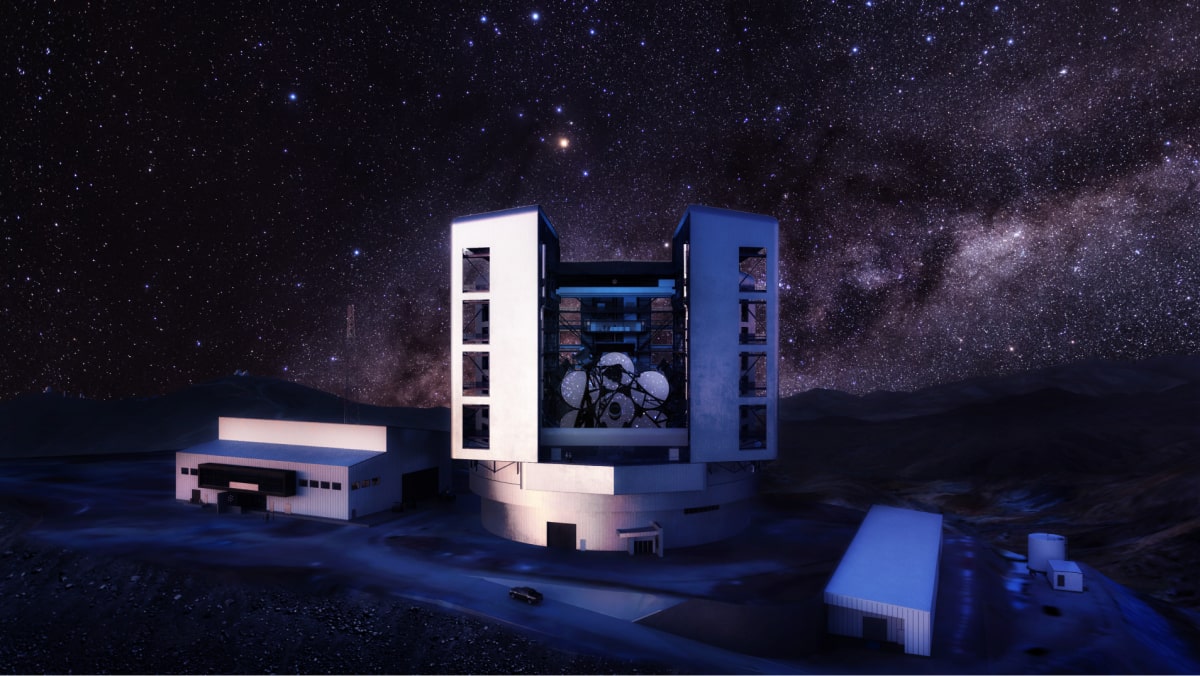
Authorities visit the construction site of a strategic science project: the Giant Magellan Telescope

Chilean ministers for Science and Environment, along with representatives from Tourism and the Ministry of Foreign Affairs, visited the summit of Cerro Las Campanas, where the Giant Magellan Telescope is being built, to learn about the progress of this international project, which positions the northern part of the country as a unique destination for world-class astronomy.
Santiago, October 2, 2026 – At an altitude of more than 2,500 meters, in one of the world’s premier locations for observing the Universe, national and regional authorities from Chile visited the Carnegie Science Las Campanas Observatory to see firsthand the construction of the Giant Magellan Telescope, one of the largest scientific infrastructure projects currently underway in Chile.
Among those in attendance were Magdalena Calcagni, head of the Emerging Technologies Division at the Ministry of Science, Technology, Knowledge, and Innovation; Katherine Pino Godoy, regional minister for Science, Technology, Knowledge, and Innovation in Atacama; David Olivares Calvo, Regional Minister for the Environment of Atacama; Jovanka Rendic Veliz, Regional Minister for the Environment of Coquimbo; Andrea Droppelmann, head of the Department of Science, Technology, Education, and Astronomy at the Ministry of Foreign Affairs; and Jorge Robledo, deputy director of Sernatur Coquimbo.
”It is fascinating to see firsthand the scale and level of engineering and technology behind this new telescope,” said Magdalena Calcagni, head of the Emerging Technologies Division at the Ministry of Science, Technology, Knowledge, and Innovation. “The fact that an international consortium has chosen Chile to host an investment of more than US$2.5 billion reaffirms our position as the world capital of astronomy.”
Currently under construction in the Atacama Desert, the Giant Magellan Telescope is part of a new generation of extremely large telescopes that will allow us to observe the Universe with unprecedented levels of sensitivity and resolution. Its design will bring together seven of the world’s largest mirrors, each measuring 8.4 meters, which will function together as a single optical surface 25.4 meters in diameter.
The gathering also provided an opportunity to discuss the importance of protecting the natural conditions that make astronomical observation possible, as the region boasts the clearest and darkest skies in the Southern Cone, positioning Chile as an international scientific hub. This represents an opportunity for the northern part of the country, driving demand for specialized services, infrastructure, technology, astro-tourism, and innovation related to the construction and future operation of one of the world’s largest scientific facilities.
“A project of the magnitude of the Giant Magellan Telescope positions Chile as one of the countries with the greatest capacity for astronomical observation from Earth,” said Andrea Droppelmann, head of the Division of Science, Energy, Education, Innovation, and Astronomy at the Chilean Ministry of Foreign Affairs. “With the new generation of observatories, the country will account for more than 50% of the world’s ground-based astronomical observation capacity. Therefore, this project places us in a privileged position globally and reinforces Chile’s role as one of the leading centers of global astronomy.”
The project’s location is a key factor in its capabilities. Las Campanas, located in the Huasco Valley south of the Atacama Desert on the border between the Atacama and Coquimbo regions, offers more than 300 nights a year with ideal conditions for optical and infrared observations, thanks to factors such as its high altitude, low water vapor content, atmospheric stability, and dark skies. These characteristics have made the northern part of the country a strategic location for world-class astronomy.
“The construction of the Giant Magellan Telescope marks a new chapter for Las Campanas. For more than five decades, the exceptional conditions at this site have enabled Carnegie Science and its partners to build the world’s most advanced telescopes here and conduct cutting-edge research in astronomy,”said Guillermo Blanc, director of the Las Campanas Observatory. “Welcoming officials to the observatory is also an opportunity to demonstrate why we must protect these skies and ensure they can continue to support astronomical research for decades to come.”
The unique features of the new telescope currently under construction will make it possible to address some of the major questions in contemporary astronomy: from studying the atmospheres of planets outside the solar system in search of signs of habitability, to understanding how stars are born and die, how galaxies evolve, and the nature of dark matter and dark energy.
Visiting the project site where construction is taking place allows one to grasp not only its scientific scope but also the opportunity it represents for the country.
“Chile has exceptional conditions that have made it a global leader in astronomy, and our challenge is to ensure that this leadership also creates opportunities for the regions that make this science possible,” said Oscar Contreras-Villarroel, vice president and representative in Chile for the Giant Magellan Telescope. “Having officials visit the project firsthand allows us to strengthen that connection and move toward a shared vision of how astronomy can contribute to science, education, tourism, and regional development, while safeguarding the astronomical sites that form the foundation of this leadership.”
With an international collaboration involving 16 leading universities and research institutions from seven countries, the Giant Magellan Telescope is scheduled to begin operations during the 2030s. Its construction and subsequent operations, projected to last more than 50 years, aim to add a new world-class scientific capability from Chile and strengthen the connection between astronomy, the country’s territory, and development, which for decades has placed the country in a privileged position to explore the Universe.
About Giant Magellan Telescope
The Giant Magellan Telescope is the future of ground-based astronomy. Using seven of the world’s largest mirrors, the 25.4-meter telescope will deliver the most detailed images of the Universe ever taken. It will uncover the cosmic mysteries of dark matter, investigate the origins of the chemical elements, and search for signs of life on distant planets. The Giant Magellan is the work of the GMTO Corporation, a 501(c)(3) nonprofit and international consortium of 16 universities and research institutions including the University of Arizona, Carnegie Institution for Science, The University of Texas at Austin, Korea Astronomy and Space Science Institute, University of Chicago, Massachusetts Institute of Technology, São Paulo Research Foundation, Texas A&M University, Northwestern University, Harvard University, Astronomy Australia Ltd., Australian National University, Smithsonian Institution, Weizmann Institute of Science, Academia Sinica Institute of Astronomy and Astrophysics, and Arizona State University. The observatory is under construction in Chile and will be completed in the 2030s. The Universe Awaits at giantmagellan.org.